School Reviews by Real Students.
  • Home
  • University
    • Federal University
    • State University
    • Private University
  • Polytechnic
    • State Polytechnic
    • Federal Polytechnic
  • college of Edu
  • Other Institutions
    • Scholarship
    • Business
    • MBA
  • Privacy Policy
  • About Us
  • Contact Us
Home » State Polytechnic
Category:

State Polytechnic

All State polytechnics in Nigeria
A picture of Kaduna State Polytechnic
State Polytechnic

Kaduna Polytechnic School Fees (2026 Update)

by Maryam A January 4, 2026
written by Maryam A

Kaduna Polytechnic (KADPOLY) remains one of Nigeria’s most prestigious and oldest polytechnics. As of the 2025/2026 academic session, the institution has updated its fee structure and admission requirements to reflect current economic realities and its mission of high-impact technology-oriented education.

Below is the fully updated guide for new and returning students.

🏛️ Kaduna Polytechnic: An Overview

Established in 1956 as the Kaduna Technical Institute, Kaduna Polytechnic is a Federal-owned (not state-owned) institution located in the heart of Kaduna. It is organized into several colleges, including the College of Engineering, College of Science and Technology, and the College of Business and Management Studies.

💰 Kaduna Polytechnic School Fees (2025/2026)

Fees at KADPOLY are categorized by program type (Regular, Evening, Weekend) and level. Please note that exact figures can vary slightly based on specific lab/workshop requirements for different departments.

Regular Programmes (ND & HND)

Level Estimated Total Fees
ND 1 / HND 1 (New Students) ₦55,000 – ₦65,000
ND 2 / HND 2 (Returning Students) ₦25,000 – ₦35,000

Evening & Weekend Programmes

Level Estimated Total Fees
ND 1 / HND 1 (New Students) ₦75,000 – ₦90,000
ND 2 / HND 2 (Returning Students) ₦60,000 – ₦70,000

Note: The “Late Registration” penalty is now ₦5,000. Students are advised to complete payments within the first two weeks of the semester to avoid this extra charge.

Acceptance and Hostel Fees

  • Acceptance Fee: All newly admitted students are required to pay a non-refundable acceptance fee of ₦15,000 (up from ₦10,000).

  • Hostel Accommodation: Due to recent renovations under the “Renovate, Operate, Maintain and Transfer” (ROMT) arrangement, hostel fees have been updated:

    • Standard Rooms: ₦20,000 – ₦25,000 per annum.

    • Note: These upgraded facilities now include improved security and constant water supply.

2026 Cut-Off Marks & Admission Requirements

For the 2025/2026 session, the JAMB General Cut-Off Mark for Kaduna Polytechnic is 100. However, departmental requirements are much higher:

Faculty / Programme UTME Cut-Off Mark
Engineering & Computer Science 160 – 180
Basic Medical Sciences (e.g., Nursing) 180
Business, Arts & Commercial Courses 140 – 150
Agricultural & Educational Courses 120

General Entry Requirements:

  1. O’Level: Minimum of 5 credits (including English and Mathematics) in relevant subjects in no more than two sittings.

  2. JAMB: Candidates must choose KADPOLY as their first choice and upload their O’level results to the JAMB CAPS portal.

Important Portals & Links

  • Application Portal: kadunapoly.edu.ng/applicants/ (Application Fee is ₦5,000 for ND and ₦10,000 for HND).

  • Payment Portal: kadunapoly.edu.ng/paykadpoly/ (All payments must be made via Remita).

  • Post-UTME Screening: postutme.kadunapoly.edu.ng/

  • Latest News: kadunapoly.edu.ng/news

Focus on Computer Engineering

The Department of Computer Engineering remains a top choice. The program spans four semesters for both ND and HND. Students gain hands-on experience in hardware maintenance, networking, and software systems.

Old Kaduna Polytechnic School Fees Payment (No Longer Valid)

The following is the school fees payment for the 2020/2021 academic session:

ND 1 Regular Programme

Registration: N4,000

Examination: N4,000

Examination Report Sheet: N2,000

Convocation: N1,000

TISHIP: N2,000

Student Hand Book: N1,500

Result Verification: N2,000

Library: N1,500

Games: N1,500

Student Bus: N1,500

Caution Deposit: N2,000

Renovation of Facilities: N1,500

Accreditation: N3,000

Identity Card: N1,000

Lab/Workshop: N3,000

Medical Examination: N1,500

SWIS: N500

SIWES: N2,000

Field Trip: N2,500

ENACTUS: N150

TOTAL: N38,150

HND 1 Regular Programme

Registration: N4,000

Examination: N4,000

Examination Report Sheet: N2,000

Convocation: N1,000

TISHIP: N2,000

Student Hand Book: N1,500

Result Verification: N2,000

Library: N1,500

Games: N1,500

Student Bus: N1,500

Caution Deposit: N2,000

Renovation of Facilities: N1,500

Accreditation: N3,000

Identity Card: N1,000

Lab/Workshop: N3,000

Medical Examination: N1,500

SWIS: N500

SIWES: 2,000

Field Trip: N2,500

ENACTUS: N150

TOTAL: N38,150

ND 2 Regular Programme

Registration: N3,000

Examination: N2,000

Examination Report Sheet: N1,000

Convocation: N1,000

TISHIP: N2,000

Student Hand Book: NIL

Result Verification: NIL

Library: N1,000

Games: N1,000

Student Bus: N500

Caution Deposit: NIL

Renovation of Facilities: N1,000

Accreditation: N2,000

Identity Card: NIL

Lab/Workshop: N2,500

Medical Examination: NIL

SWIS: N500

SIWES: NIL

Field Trip: NIL

ENACTUS: N150

TOTAL: N17,650

HND 2 Regular Programme

Registration: N3,000

Examination: N2,000

Examination Report Sheet: N1,000

Convocation: N1,000

TISHIP: N2,000

Student Hand Book: NIL

Result Verification: NIL

Library: N1,000

Games: N1,000

Student Bus: N500

Caution Deposit: NIL

Renovation of Facilities: N1,000

Accreditation: N2,000

Identity Card: NIL

Lab/Workshop: N2,500

Medical Examination: NIL

SWIS: N500

SIWES: NIL

Field Trip: NIL

ENACTUS: N150

TOTAL: N17,650

Evening/Weekend Programmes

ND 1

Registration: N30,000

Examination: N4,000

Examination Report Sheet: N2,000

Convocation: N2,000

TISHIP: N1,500

Student Hand Book: N2,000

Result Verification: N2,000

Library: N1,500

Games: N1,500

Student Bus: N1,500

Caution Deposit: N2,000

Renovation of Facilities: N1,500

Accreditation: N3,000

Identity Card: N1,000

Lab/Workshop: N3,000

Medical Examination: N1,500

SWIS: N500

SIWES: N2,000

Field Trip: N2,500

ENACTUS: N150

TOTAL: N61,150

ND 2

Registration: N26,000

Examination: N4,000

Examination Report Sheet: N2,000

Convocation: N2,000

TISHIP: N1,500

Student Hand Book: NIL

Result Verification: NIL

Library: N1,500

Games: N2,000

Student Bus: N1,500

Caution Deposit: NIL

Renovation of Facilities: N1,500

Accreditation: N3,000

Identity Card: NIL

Lab/Workshop: N3,000

Medical Examination: NIL

SWIS: N500

SIWES: N1,000

Field Trip: N2,500

ENACTUS: N150

TOTAL: N52,650

HND 2

Registration: N26,000

Examination: N4,000

Examination Report Sheet: N2,000

TISHIP: N1,500

Student Hand Book: NIL

Result Verification: NIL

Library: N1,500

Games: N2,000

Student Bus: N1,500

Caution Deposit: NIL

Renovation of Facilities: N1,500

Accreditation: N3,000

Identity Card: NIL

Lab/Workshop: N3,000

Medical Examination: NIL

SWIS: N500

SIWES: N2,000

Field Trip: N2,500

ENACTUS: N150

TOTAL: N53,650.

Logo of Kaduna State Polytechnic

Kaduna State Polytechnic School Fees for HND

HND 1 Regular Programme

Registration: N4,000

Examination: N4,000

Examination Report Sheet: N2,000

Convocation: N1,000

TISHIP: N2,000

Student Hand Book: N1,500

Result Verification: N2,000

Library: N1,500

Games: N1,500

Student Bus: N1,500

Caution Deposit: N2,000

Renovation of Facilities: N1,500

Accreditation: N3,000

Identity Card: N1,000

Lab/Workshop: N3,000

Medical Examination: N1,500

SWIS: N500

SIWES: 2,000

Field Trip: N2,500

ENACTUS: N150

TOTAL: N38,150

HND 2 Regular Programme

Registration: N3,000

Examination: N2,000

Examination Report Sheet: N1,000

Convocation: N1,000

TISHIP: N2,000

Student Hand Book: NIL

Result Verification: NIL

Library: N1,000

Games: N1,000

Student Bus: N500

Caution Deposit: NIL

Renovation of Facilities: N1,000

Accreditation: N2,000

Identity Card: NIL

Lab/Workshop: N2,500

Medical Examination: NIL

SWIS: N500

SIWES: NIL

Field Trip: NIL

ENACTUS: N150

TOTAL: N17,650

Kaduna Polytechnic Courses and Requirements

Here are some of the courses offered in Kaduna Polytechnic and their UTME requirements:

Accountancy

Mathematics, English Language and two subjects from the following:

  • Government
  • Geography
  • Economics
  • Commerce
  • Principles of Accounts

Business Administration and Management

Mathematics, English Language and two subjects from the following:

  • Government
  • Geography
  • Economics
  • Commerce
  • Principles of Accounts

Chemical Engineering Technology

  • Mathematics
  • English Language
  • Chemistry or Technical Drawing
  • Physics

Electrical/Electronics Engineering

  • Mathematics
  • English Language
  • Chemistry or Technical Drawing
  • Physics

Estate Management and Valuation

English Language, Mathematics, and two subjects from the list below:

  • Physics
  • Technical Drawing
  • Economics/Commerce
  • Woodwork
  • Fine Art
  • Literature
  • Geography
  • Chemistry
  • Biology
  • Metal Work
  • Government
  • Principles of Accounts and Book Keeping

Quantity Surveying

English Language and any three subjects from the list below:

  • Mathematics
  • Physics
  • Biology/Agricultural Science
  • Economics
  • Geography

Kaduna Polytechnic Courses and Cut Off Mark

Agricultural and Educational courses: A minimum of 120 in UTME.

Engineering courses: A minimum of 180 in UTME.

Basic Medical Sciences courses: A minimum of 180 in UTME.

Other courses in faculties such as Physical and Natural Sciences, Art, and Commercial: A minimum of 150 in UTME.

Kaduna Polytechnic Acceptance Fees

The acceptance fee at Kaduna Polytechnic costs N10,000.

KADPOLY Hostel Fees

The hostel fee is between N5,000 to N10,000 per student.

Kaduna Polytechnic News

Stay up to date with the latest news and events in Kaduna State Polytechnic by visiting this link: https://kadunapoly.edu.ng/news

Kaduna Polytechnic Application Form

To access the application form, kindly visit the following link: https://kadunapoly.edu.ng/applicants/

Kaduna Polytechnic Payment Portal

Click here, https://kadunapoly.edu.ng/paykadpoly/, to visit the payment portal.

KADPOLY Computer Engineering

Computer Engineering is one of the departments in the College of Engineering. The duration for studying the course at KADPOLY is four semesters.


January 4, 2026 0 comments
0 FacebookTwitterPinterestWhatsappTelegramCopy LinkEmail
A picture of Lagos State Polytechnic
Federal PolytechnicPolytechnicState Polytechnic

[Detailed] Polytechnic Grading System in Nigeria. (2026 Update)

by Maryam A January 3, 2026
written by Maryam A

In Nigeria, the polytechnic grading system is regulated by the National Board for Technical Education (NBTE). As of 2026, polytechnics have strictly adhered to the standardized unified grading system to ensure National Diploma (ND) and Higher National Diploma (HND) certificates carry the same weight across all institutions.

Unlike universities that primarily use a 5.0 scale, polytechnics use a 4.0 scale.

2026 Standardized Unified Grading System

The table below illustrates the currently approved scoring range, letter grades, and their corresponding weight (Grade Points) for Nigerian polytechnics.

Score Range (%) Letter Grade Grade Point (GP)
75 – 100 A 4.00
70 – 74 AB 3.50
65 – 69 B 3.25
60 – 64 BC 3.00
55 – 59 C 2.75
50 – 54 CD 2.50
45 – 49 D 2.25
40 – 44 E 2.00
0 – 39 F 0.00

Official Diploma Classification

At the end of your ND or HND program, your Cumulative Grade Point Average (CGPA) determines your final class of diploma:

CGPA Range Class of Diploma
3.50 – 4.00 Distinction
3.00 – 3.49 Upper Credit
2.50 – 2.99 Lower Credit
2.00 – 2.49 Pass
0.00 – 1.99 Fail

NBTE Note: To progress from a National Diploma (ND) to a Higher National Diploma (HND), most institutions require a minimum of Lower Credit (2.50). Students with a Pass (2.00–2.49) must typically complete two years of Industrial Training (IT) instead of one before becoming eligible for HND admission.

GPA System for Polytechnic Students

The table below shows the GPA system for polytechnic students:

Score (in percentage) Grade Grade Point Final CGPA Class of Degrees
100-80 A 4.00 3.50 – 4.00 Distinction
79-70 AB 3.50 3.00 – 3.49 Upper Credit
60-69 B 3.00 2.50 – 2.99 Lower Credit
59-50 BC 2.50 2.00 – 2.49 Pass
49-40 C 2.00 0.00 – 1.99 Fail

How to calculate GPA for first semester OND 1

Let’s assume you offer the courses (listed below) and obtain grades as depicted in the table. The GPA can be calculated thus:

Course Code Credit Unit Grade Grade Points Quality Points (CU X GP) Total Points
GSP 101 3 A 4.00 2 X 4.00 8.00
GSP 105 2 B 3.00 2 X 3.00 6.00
GSP 111 2 C 2.00 2 X 2.00 4.00
GSP 201 2 C 2.00 2 X 2.00 4.00
COS 101 2 AB 3.50 2 X 3.50 7.00
STA 131 2 B 2.00 2 X 2.00 4.00
MTH 221 2 BC 2.50 2 X 2.50 5.00
TOTAL CREDIT UNITS 15 38

To calculate the first semester OND 1, use the following formula:

GPA = Total Points/ Total Credit Units =38/15 = 2.5

The first semester GPA is, therefore 2.5

How to calculate GPA for second semester OND 1

Let’s assume you offer the courses (listed below) and obtain grades as depicted in the table. The GPA can be calculated thus:

Course Code Credit Unit Grade Grade Points Quality Points (CU X GP) Total Points
 GLG 142 2 AB 3.50 2 X 3.50 7.00
 GSP 208 2 B 2.00 2 X 2.00 4.00
 GSP 202 2 C 2.00 2 X 2.00 4.00
 PHY 196 3 C 2.00 2 X 2.00 4.00
 GSP 106 2 BC 2.50 2 X 2.50 5.00
 CHM 112 2 B 2.00 2 X 2.00 4.00
 GSP 106 3 B 3.00 2 X 3.00 6.00
TOTAL CREDIT UNITS 16 34

To calculate the second semester OND 1, use the following formula:

GPA = Total Points/ Total Credit Units =34/16 = 2.1

The second semester GPA is, therefore 2.1

To calculate the cumulative grade point average (CGPA) for National Diploma (ND) 1, add the GPA of the first and second semesters and divide by 2 (the number of semesters). This is calculated to obtain the average.

The calculation goes thus:

OND 1 CGPA = (First Semester ND 1 GPA + Second Semester ND 1 GPA) / 2 = (2.5 + 2.1) / 2

CGPA = 4.6 / 2 = 2.3

Explanation of each Grade Level in a Polytechnic Setting

3.50 – 4.00 CGPA attracts a ‘Distinction’ class of degree. This is synonymous to a First Class degree in a Nigerian university.

Upper Credit class of degree is awarded to a student with 3.00 – 3.49 CGPA. This is synonymous with Second Class Honours (Upper Division) in Nigerian universities.

2.0 – 2.00 CGPA attracts a ‘Lower Credit’ degree. This is synonymous with a ‘Second Class Honours’ (Lower Division) in Nigerian universities.

The same explanation goes for the ‘Pass’ and ‘Fail’ classes of degrees.

Why Understanding This Matters in 2026

  • HND Admissions: In 2026, competition for HND slots is high. Maintaining an Upper Credit significantly increases your chances of getting into top-tier polytechnics like Yaba College of Technology or Federal Polytechnic, Nekede.

  • University Direct Entry: If you plan to switch to a university, a Distinction (3.50+) is often required for competitive courses like Engineering or Accounting.

  • Employment: Many government agencies and private firms in Nigeria specifically request “at least a Lower Credit” for entry-level positions.

Relevant External Links

  • National Board for Technical Education (NBTE): The official regulatory body for technical education in Nigeria.

  • NBTE Digital Curriculum Portal: Access the specific credit unit requirements for your department.

  • JAMB IBASS: For checking the latest HND and Direct Entry requirements.

January 3, 2026 0 comments
0 FacebookTwitterPinterestWhatsappTelegramCopy LinkEmail
A picture of a lecturer writing down notes on the white board.
Federal PolytechnicPolytechnicState Polytechnic

Everything You Need to Know About Polytechnic Lecturers Salary Scale in Nigeria (Updated Year 2026)

by Maryam A January 3, 2026
written by Maryam A

In Nigeria, the salary scale for polytechnic lecturers is governed by the Consolidated Polytechnics and Colleges of Education Academic Staff Salary Structure (CONPCASS). As of 2026, these figures have been significantly revised upward following the federal government’s 2024/2025 implementation of the National Minimum Wage Act and the 25%–35% consequential salary adjustments for tertiary institution staff.

Below is the updated guide for the 2026 salary scale for polytechnic lecturers in Nigeria.

2026 Salary Scale by Lecturer Grade

The total emoluments listed below are gross annual salaries (before statutory deductions like PAYE tax, pension, and NHIS). These figures now include the 2024/2025 consolidated increments approved by the Federal Government.

Chief Lecturer (Highest Grade)

In the polytechnic system, the Chief Lecturer is the equivalent of a University Professor. This is the peak of the academic career in a polytechnic.

  • Minimum Salary: Approximately ₦7,320,000 per annum (~₦610,000 per month).

  • Maximum Salary (Step 10+): Can reach up to ₦9,476,000 per annum (~₦789,000 per month).

Principal Lecturer / Reader

Equivalent to an Associate Professor, these are high-level academic leaders.

  • Minimum Salary: Approximately ₦5,700,000 per annum (~₦475,000 per month).

  • Maximum Salary: Approximately ₦7,410,000 per annum (~₦617,000 per month).

Senior Lecturer

  • Minimum Salary: Approximately ₦3,510,000 per annum (~₦292,000 per month).

  • Maximum Salary: Approximately ₦4,270,000 per annum (~₦356,000 per month).

Lecturer I

  • Minimum Salary: Approximately ₦2,880,000 per annum (~₦240,000 per month).

  • Maximum Salary: Approximately ₦3,360,000 per annum (~₦280,000 per month).

Lecturer II

  • Minimum Salary: Approximately ₦2,590,000 per annum (~₦216,000 per month).

  • Maximum Salary: Approximately ₦2,910,000 per annum (~₦242,000 per month).

Assistant Lecturer / Lecturer III

The entry-level position for Master’s degree holders.

  • Minimum Salary: Approximately ₦2,320,000 per annum (~₦193,000 per month).

  • Maximum Salary: Approximately ₦2,590,000 per annum (~₦216,000 per month).

Graduate Assistant

Entry-level position for Bachelor’s degree holders (First Class or 2:1).

  • Minimum Salary: Approximately ₦1,850,000 per annum (~₦154,000 per month).

  • Maximum Salary: Approximately ₦2,100,000 per annum (~₦175,000 per month).

Detailed CONPCASS Salary Table (Consolidated 2026)

The table below illustrates the CONPCASS per annum across various levels. This structure integrates basic salary with consolidated allowances (rent, journal, research, and field trip allowances).

CONPCASS Level Step 1 (₦) Step 5 (₦) Step 10 (₦)
01 (Asst. Lecturer) 2,327,556 2,541,444 2,800,000
03 (Lecturer II) 2,599,716 2,851,464 3,160,000
05 (Senior Lecturer) 3,511,656 3,949,560 4,277,988
07 (Chief Lecturer) 7,328,844 8,282,088 9,476,688

Factors Influencing Salary and Promotions

  1. Academic Publications: Promotions (and thus salary jumps) depend heavily on the number of papers published in peer-reviewed journals.

  2. Years of Service: Each grade has “Steps.” Annual increments occur within a grade until you move to the next rank.

  3. Type of Institution: While Federal Polytechnics follow the IPPIS/CONPCASS strictly, State Polytechnics may vary slightly depending on the state’s financial capacity. Private polytechnics set their own competitive rates.

  4. Administrative Roles: Holding positions like Head of Department (HOD), Dean, or Rector comes with additional responsibility allowances

Important Links & Resources

  • National Salaries, Incomes and Wages Commission (NSIWC): The official body for all government salary circulars in Nigeria.

  • National Board for Technical Education (NBTE): For information on polytechnic accreditation and staff standards.

  • Academic Staff Union of Polytechnics (ASUP): For updates on industrial negotiations and welfare.

Old Grades of Lecturers and their Salary Scale (For Previous Years)

Below are lecturer grades in Nigerian institutions and their salary scale.

The total emoluments are calculated before pension contribution and tax deductions. It also includes rent and academic allowances.

Professor

Professor, popularly called Prof, is the highest academic in Nigerian institutions.

Professors are typically experts in their fields and top-tier lecturers.

A professor earns a minimum salary of 381,695 Naira per month and 4,580,349 Naira annually.

The minimum salary after ten years is 501,680 Naira per month and 6,020,163 Naira annually.

Senior Lecturer

A senior lecturer is a member of the faculty in a university or other similar higher institution.

A senior lecturer’s minimum salary is 257,625 Naira per month and 3,091,505 Naira annually.

The maximum salary after thirteen (13) years is 371,292 Naira per month and 4,455,506 Naira annually.

Lecturer I

Lecturer I earns a minimum monthly salary of 173,332 Naira per month and 2,079,995 Naira on an annual basis.

The maximum salary after nine (9) years is 223,667 Naira per month and 2,684,010 Naira annually.

A photo of a lecturer talking to his students.

Lecturer II

Lecturer II earns 137,459 Naira per month and 1,649,509 Naira per year.

After eight (8) years, the maximum salary will be 164,970 Naira monthly and 1,979,640 Naira annually.

Assistant Lecturer

The Assistant lecturer is a position Master’s degree holders assume at entry level.

The minimum salary of Lecturer III is 120,922 Naira per month and 1,451,071 Naira per year.

After eight (8) years, the maximum salary is 146,241 Naira per month and 1,754,902 Naira per year. 

Graduate Assistant

Graduate Assistant is the entry-level position for a Bachelor’s degree holder.

The minimum salary of a Graduate Assistant is 105,281 Naira per month and 1,263,377 Naira per year.

After six (6) years, the maximum salary is 120,647 Naira on a monthly basis and 1,447,767 Naira on an annual basis. 

Reader

A Reader’s minimum salary on a monthly basis is 314,018 Naira. A Reader earns 3,768,221 Naira annually.

After ten (10) years, the maximum salary is 417,062 Naira per month and 5,004,750 Naira per annum.

This list of salaries applies to lecturers in federal and state universities.

The salaries of lecturers in private universities might be completely different.

The following factors can affect the amount of salary a lecturer earns:

  • Numbers of publication.
  • The role’s responsibilities.
  • The university someone lectures.
  • The faculty.

Old Consolidated Polytechnic Salary Structure (For Previous Years)

The table below shows the Consolidated Polytechnic & Colleges of Education Academic Staff Salary Structure (CONPASS) per annum.

(Level 1-6)

CONPASS 1 (N) 2 (N) 3 (N) 4 (N) 5 (N) 6 (N)
01 1257460 1300238 1343017 1385795 1428573 1471351
02 1460038 1510386 1560735 1611085 1161433 1711783
03 1693790 1748497 1803205 1857913 1912620 1967327
04 1906230 1989066 2071903 2154739 2237575 2320411
05 2127402 2214985 2302566 2390149 2477732 2565313
06 2349600 2443887 2538171 2632456 2726743 2821028
07 3020925 3146527 3272130 3397732 3523334 3648934
08 3716263 3868081 4019901 4171719 4323537 4475355
09 4561073 4737651 4914628 5089682 5268183 5444959

 (Level 7-11)

CONPASS 7 (N) 8 (N) 9 (N) 10 (N) 11 (N)
01 1514130 1556908 1599686 1642464 1685243
02 1762132 1812482 1862830 1913180 1963528
03 2022036 2076743 2131450 2186157 2240866
04 2403247 2486083 2568919 2651755 2734592
05 2652896 2740479 2828060 2915643 3003155
06 2915314 3009599 3103885 3198170
07 3774536 3900139 4025741
08 4627173 4778991 4930809
09 5621738 5798513 5975291

 (Level 12-15)

CONPASS 12 (N) 13 (N) 14 (N) 15 (N)
01 1728023 1770801 1813579 1856358
02 2013878 2064227 2114575 2164925
03 2295573 2064227 2404987 2459696
04
05
06
07
08
09


January 3, 2026 0 comments
0 FacebookTwitterPinterestWhatsappTelegramCopy LinkEmail
UNIABUJA notice to SIWES students
State Polytechnic

Admission into New ND Programs at Delta Polytechnic Ogwashiuku 2021/2022

by ajibolaaina March 13, 2022
written by ajibolaaina

This is to notify all interested and qualified applicants that the Post-UTME Screening Exercise for Admission into the following NBTE certified ND Programmes at Delta State Polytechnic, Ogwashi-uku for the 2021/2022 Academic Session will take place as specified below.

Requirements

Candidates that selected Delta State Polytechnic Ogwashi-uku as their first or second option and achieved a score of 100 or above in the 2021 Unified Tertiary Matriculation Examination

Candidates who did not initially pick Delta State Polytechnic, Ogwashi-uku but who now desire to be considered for admission and scored 100 or higher in the 2021 Unified Tertiary Matriculation Examination (UTME). Only those who participated in the UTME in 2021 are eligible to apply.

Candidates must have obtained at least Five (5) Credit Passes in SSCE (WAEC & NECO), GCE O’Level, NABTEB or its equivalent in relevant disciplines, including English Language and Mathematics, in not more than two (2) Sittings in order to be considered for admission.

How to apply

  • Pay a non-refundable Screening charge of Two Thousand Nalra (2.000 00) only. made online with the Verve or Master Card Inter Switch payment systems (ATM).
  • made online with the Verve or Master Card Inter Switch payment systems (ATM). Log on to https://mydspg.edu.ng and select Admission from the drop-down menu, followed by ND Application Form.
  • To acquire your Application Form, please complete the form with the needed information and submit it.

Screening Procedure

In accordance with their qualifying admission requirements, all Candidates will be subjected to a physical and online screening process. The deadline for submission of applications is Thursday, March 31, 2022.

Note: All candidates should double-check their SSCE results and Result Checkers cards to confirm that they have been appropriately entered.

March 13, 2022 0 comments
0 FacebookTwitterPinterestWhatsappTelegramCopy LinkEmail
UNIABUJA notice to SIWES students
State Polytechnic

Admission list for National Diploma students at Gombe State Polytechnic 2021/2022

by ajibolaaina March 12, 2022
written by ajibolaaina

This is to alert all prospective students of Gombe State Polytechnic that the administration has issued the National Diploma Admission List for the 2021/2022 Academic Session.

Students who have been accepted must report for screening and registration between the 28th of March and the 15th of April, 2022.

REGISTRATION PROCEDURE.

1. Successful applicants should download their admission letters from the school site – www.gspb.edu.ng – and report to their respective Heads of Departments for screening/clearance, bringing original copies of their results and other credentials with them.

2. After receiving clearance (as described in point 1 above), candidates should move to the MIS/ICT Unit for online clearance.

3. To make a payment for their school tuition, candidates should log in to their portal (using their Application Number as the user name and their Password as the “password”). If your account has not been cleared on the portal, you will not be able to make payments for registration fees and course registration using the site. The candidates who choose to utilize the Bank branch option should print the Payment Reference number obtained and bring it with them to the bank for payment. Alternatively, you can use your ATM card or a bank transfer to complete the transaction online.

4. Your REGISTRATION NUMBER is now created and printed together with your Payment Slip after you have made your payment.

5. Proceed to the Bursary Department, where you will submit your payment slip and get a receipt for your payment that has been officially signed by you.

6. go to the Polytechnic’s Medical Center for medical evaluations, using the forms that were downloaded with the acceptance letter as a starting point.

7. Return to the MIS/ICT Unit to pick up your registered courses, and then proceed to your various departments/schools to get the signatures of the Head of Department and the Class Advisor on your registered courses.

8. Make three (3) copies of any forms, receipts, and credentials that have been downloaded and correctly filled out, and then bring them to the Academic Office for validation. (The Academic Office will only consider your registration to be genuine if it has been validated by you.)

9. Report to the security unit for the issuing of a temporary identification card.

10. Make three (3) copies of your temporary ID card and place them in the three (3) files: two (2) copies should be submitted to the Academic Office and one (1) copy should be submitted to your Department for final documentation.

March 12, 2022 0 comments
0 FacebookTwitterPinterestWhatsappTelegramCopy LinkEmail
State Polytechnic

Notice to newly enrolled students at Imo Poly on the collection of matriculation gowns

by ajibolaaina March 10, 2022
written by ajibolaaina

This is to notify all matriculating students at the Polytechnic that they must report to the Stores Unit by 9.00 a.m. on Tuesday, March 8, 2022, to pick up their matriculation gowns.

Please take note that all matriculating students are required to wear their gowns for the matriculation ceremony scheduled for Thursday, March 10, 2022, at the Imo State Polytechnic, Omuma main campus.

It is recommended that you adhere strictly to the guidelines outlined above.

March 10, 2022 0 comments
0 FacebookTwitterPinterestWhatsappTelegramCopy LinkEmail
State Polytechnic

Notice to NDII and HNDII students from the Kogi State Polytechnic

by ajibolaaina March 10, 2022
written by ajibolaaina

This is to inform our ex-students, including the most recent NDII and HNDII students of the above-mentioned School, that you are all required to evacuate the school grounds as you are regarded to have completed your respective programmes and are no longer considered to be students of the institution.

Notice to NDII and HNDII students from the Kogi State Polytechnic   This is to inform our ex-students, including the most recent NDII and HNDII students of the above-mentioned School, that you are all required to evacuate the school grounds as you are regarded to have completed your respective programmes and are no longer considered to be students of the institution.      All parties involved are urged to take the appropriate action.  (Image: Notice to NDII and HNDII students from the Kogi State Polytechnic)

All parties involved are urged to take the appropriate action.

March 10, 2022 0 comments
0 FacebookTwitterPinterestWhatsappTelegramCopy LinkEmail
UNIABUJA notice to SIWES students
State Polytechnic

Admissions to IMAP’s Pre-ND Program 2021/2022

by ajibolaaina March 8, 2022
written by ajibolaaina

Isa Mustapha Agwai Polytechnic prospective students are hereby informed that the management of the institution has issued the Approved Pre-National Diploma Admission list for the 2021/2022 academic session.

The names of those who have been accepted have been placed on the school’s bulletin board.

Admissions to IMAP's Pre-ND Program in 2021/2022

Candidates should proceed to the board to verify if their names are listed there.

March 8, 2022 0 comments
0 FacebookTwitterPinterestWhatsappTelegramCopy LinkEmail
UNIABUJA notice to SIWES students
State Polytechnic

Taraba State Polytechnic 2021/2022 admission list

by ajibolaaina March 3, 2022
written by ajibolaaina

The Supplementary Admissions List for Taraba State Polytechnic has been released. This is to alert potential students of Taraba State Polytechnic that the Supplementary Admission List for the 2021/2022 Session has been issued by the institution’s administration.

The list of accepted students has been published and made available on the school’s website. To verify your identity, follow the steps outlined below.

How to check your admissions status

  • Go to https://tarabapoly.edu.ng/portal/index.php to get started.
  • Select Admissions List from the drop-down menu.
  • Select Session as “2021/2022” and Batch as “supplementary” from the drop-down menu.
  • To double-check your name, click on the submit button.

Goodluck!

March 3, 2022 0 comments
0 FacebookTwitterPinterestWhatsappTelegramCopy LinkEmail
PolytechnicState Polytechnic

BENPOLY notice on screening exercise for applicants 2022

by ajibolaaina March 3, 2022
written by ajibolaaina

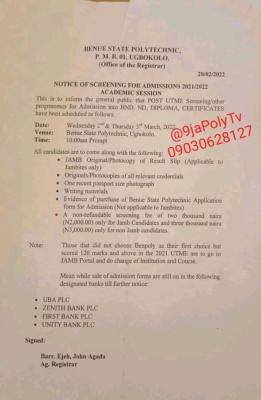
This is to advise the general public that the following programs for admission into HND, ND, DIPLOMA, and CERTIFICATES of the Benue State Polytechnic have been planned as part of the Post-UTME Screening/Other Programmes:

Dates: March 2nd and 3rd, 2022 (Wednesday and Thursday).

Time: 10 a.m. Prompt

All candidates are required to bring the following items with them:

  • Original or photocopy of the JAMB Result Slip (Applicable to Jambites only)
  • Originals or photocopies of all necessary credentials are required.
  • A current passport-sized image; writing supplies; and
  • Documentation showing that you have purchased the Benue State Polytechnic Application for Admission (Not applicable to Jambites)

BENPOLY notice on screening exercise for applicants 2022

Jamb candidates only will be charged a non-refundable screening fee of two thousand naira (N2,000.00), while non-Jamb candidates will be charged a price of three thousand naira (N3,000.00).

It is important to note that students who did not select Benpoly as their first option but received 120 points or more in the 2021 UTME must go to the JAMB Portal and request a change of Institution and Course.

In the meantime, admission forms are still available for purchase from the following recognized banks until further notice:

  1. UBA PLC (United Bank of Africa)
  2. FIRST BANK PLC
  3. UNITY BANK PLC
  4. ZENTIH BANK PLC
March 3, 2022 0 comments
0 FacebookTwitterPinterestWhatsappTelegramCopy LinkEmail
Newer Posts
Older Posts
  • Business
  • college of Edu
  • Education
  • Federal Polytechnic
  • Federal University
  • FUTA
  • MBA
  • Other Institutions
  • Polytechnic
  • Private University
  • Scholarship
  • State Polytechnic
  • State University
  • Uncategorized
  • University

IMPORTANT LINKS

  • About Us
  • Contact Us
  • Privacy Policy
Footer Logo
  • About Us
  • Contact Us
  • Privacy Policy

@2020 - All Right Reserved. Designed and Developed by Wapzola


Back To Top
School Reviews by Real Students.
  • Home
  • University
    • Federal University
    • State University
    • Private University
  • Polytechnic
    • State Polytechnic
    • Federal Polytechnic
  • college of Edu
  • Other Institutions
    • Scholarship
    • Business
    • MBA
  • Privacy Policy
  • About Us
  • Contact Us