Hello, welcome and thank you for taking the time to read this guide. In this article, I am going to be explaining exactly what happens when candidates do not make the official departmental cut-off marks for their chosen course.
Additionally, I will break down the course transfer and change of course process, what to do if you are considered for a course transfer, how to monitor your admission status, how to properly accept an admission offer, acceptance fee payments, online screening, and the essential documents you will need after being offered admission.
If you are a candidate dealing with any of these admission hurdles, you need to follow these steps attentively to avoid making costly mistakes.
Disclaimer: Please note that the information provided here does not represent any official university office or admissions body. This guide is compiled strictly for educational purposes. For the sake of clarity and practical examples, the University of Ibadan (UI) will be used as our primary case study throughout this explanation.
Also check out: The Ultimate Guide to JAMB Direct Entry (DE) 2026 Registration: Steps, Requirements, and Rules
Part 1: Missing the Cut-Off Mark — The Two Categories of Candidates
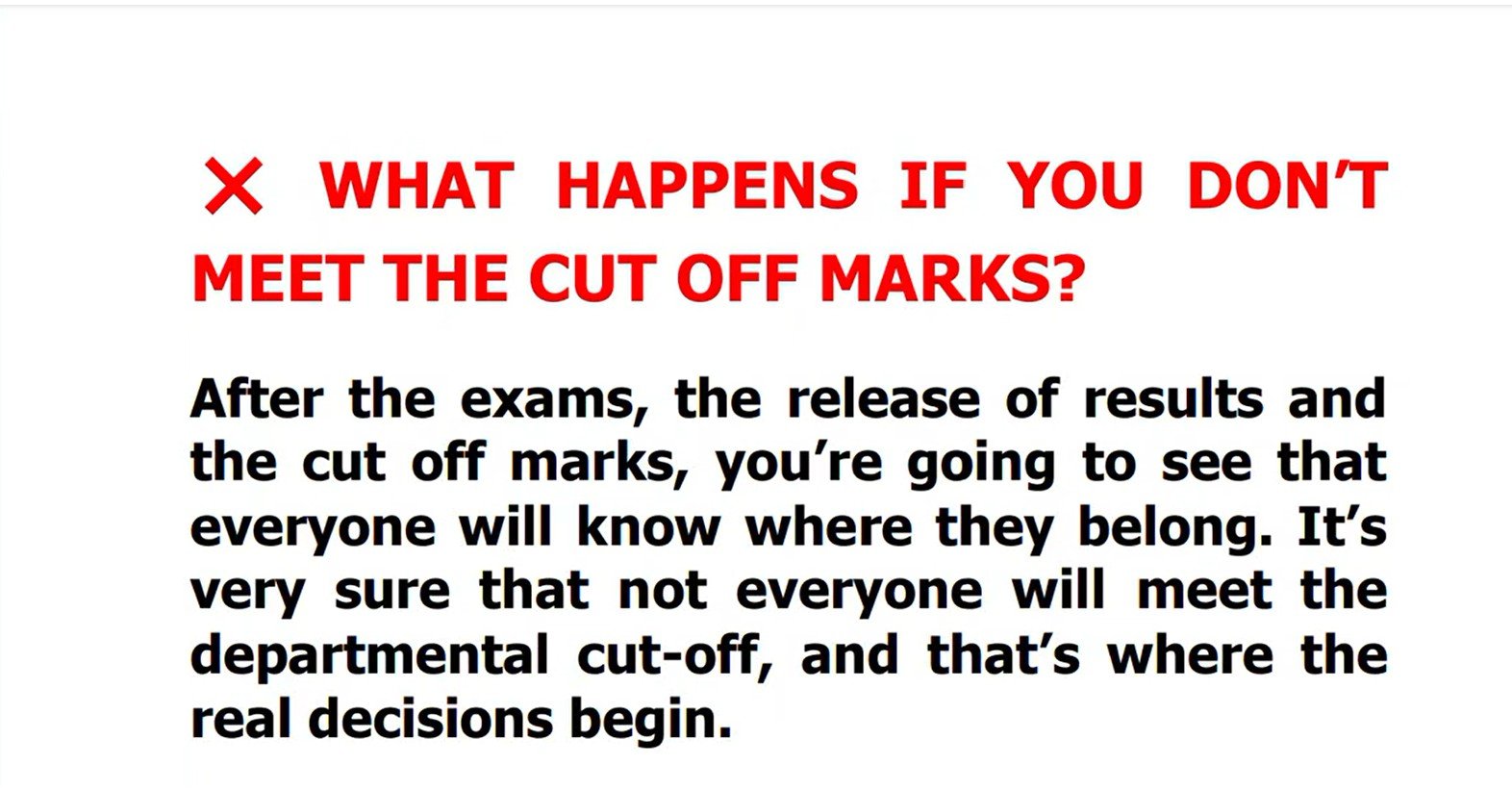
After your post-UTME examinations, universities release the official results alongside departmental cut-off marks. Once these are live, every candidate knows immediately where they stand.
When you miss the benchmark for your target department, your next steps depend entirely on which of the following two categories you fall into:
Category 1: Candidates Who Scored Below 50% in Post-UTME
According to institutional admission policies (such as the University of Ibadan’s), candidates who score below 50% in the post-UTME screening will not be considered for regular merit admission at all. If you fall into this category, you have three distinct options:
Change Your Institution Immediately: You should look for other universities whose admission portals are still open and switch your institution on the JAMB portal as soon as possible. Because JAMB sets strict overall admission deadlines, making this decision early ensures you still have multiple choices and a fighting chance at securing a spot elsewhere.
Consider Distance Learning: If your ultimate goal is still to graduate with a certificate from your chosen school (e.g., University of Ibadan), you can look into the Distance Learning Centre (DLC) as an excellent alternative.
Prepare to Come Back Stronger: You can choose to take a gap year, study extensively, and reapply for admission the following year.
Note: If you fall into this category and are actively looking for institutions that are still selling admission forms for the current academic year, you can reach out to me via WhatsApp for a paid consultation session.
Category 2: Candidates Who Passed Post-UTME (50%+) but Missed the Departmental Cut-Off
This category consists of candidates who passed the post-UTME by scoring 50% or above, and whose overall aggregate score is very close to their department’s cut-off mark, but still slightly below it.
For these candidates, the university will sometimes offer a Course Transfer Option to fill vacant spaces in other departments that still have available slots. However, specific conditions must be met before the school initiates this transfer, which we will detail below.
Part 2: Course Transfer vs. Personal Change of Course
We receive countless questions from anxious students asking: “Can I change my course now? Is the change of course form out?”
There are specific periods during the admission cycle when it is safe to initiate a change of course, and periods when it is completely unsafe. After the university releases its departmental cut-off marks, it is no longer safe to change your course on your own.
Crucial Warning on Premature Changes
You cannot personally determine or guess which course you should change to at this stage. The admissions office solely decides who gets transferred and where they go.
The primary determining factors the school uses are:
Your overall post-UTME aggregate score.
Your O’ Level results and subject combinations.
For example, if you originally applied for a department that required English Language, Biology, Physics, and Chemistry, and you possess those credits, the university can only transfer you to an alternative department that accepts that exact same combination. They cannot transfer you to a department requiring Mathematics instead of Biology.
[Original Course Combination] ➔ [Missed Cut-Off] ➔ [Automated Matching by Admission Office] ➔ [Valid Alternative Course Transfer]
Many candidates make the mistake of waking up and changing their course to a department whose basic subject requirements they do not even meet. Furthermore, changing your course without being formally advised to do so by the school is a complete waste of time and money.
The cut-off mark represents the aggregate score of the very last person admitted into that specific department. This means the department has already concluded its selections and filled its quota. If you blindly change your course to a department that is already full, you will not be admitted. If you cannot wait for the university’s automated course transfer process, your best move is to change your institution entirely.
Part 3: Understanding the Course Transfer Process
Unless you are explicitly considered for a course transfer and advised by the institution to swap, do not touch the change of course button.
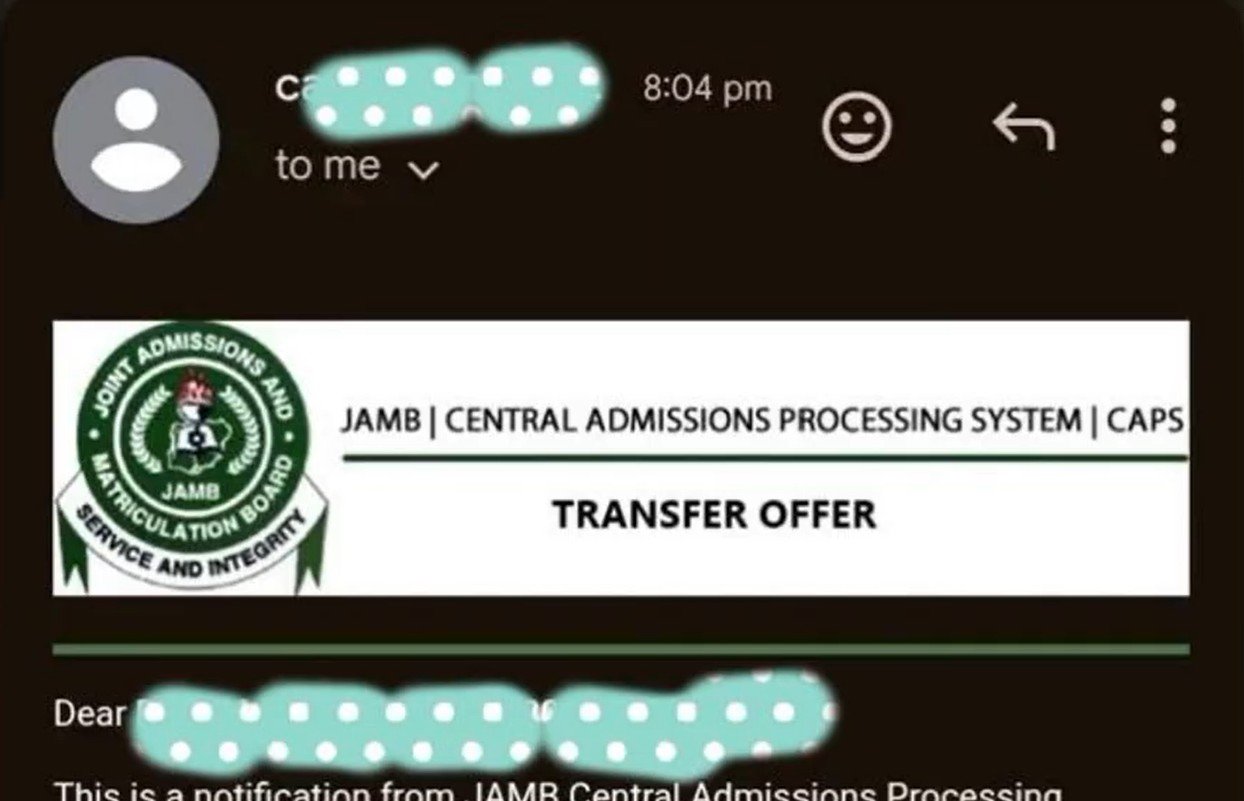
The course transfer process is managed entirely by the university’s admissions office. If the school determines that you qualify for an alternative program, a formal transfer offer will appear on your JAMB CAPS (Central Admissions Processing System) portal. JAMB may also send an automated notification directly to your registered email address.
What the Notification Looks Like
The email notification from JAMB will explicitly state your original choice of course versus the new program the university is offering you. For example, it will display that you originally applied for Civil Engineering but are now being considered for a transfer into Logistics and Transport Management.
This transfer offer will reflect directly under the “Transfer Window” section on your JAMB CAPS dashboard.
Tip: If you do not know how to access or navigate this section, look through the playlist on this channel for our detailed video guide explaining how to log into JAMB CAPS and monitor your transfer window.
Key Facts About Course Transfers
It is not guaranteed: Course transfers are not available to every single candidate because the university has a strict limit on the total number of students it can admit.
New programs provide opportunities: Every year, universities may introduce newly accredited courses. Because no prior candidates applied directly to these new departments, they often serve as excellent landing spots for transferred students.
It is a privilege, not a right: If you receive a transfer offer, you are completely free to either accept or reject it based on your interest in the new course.
Rejection protocols: If you reject the offer, you might be considered for a different course if slots are available, but this is rare. The first offer is often your best chance, so think carefully before rejecting it.
Part 4: Step-by-Step Guide to Completing Your Course Transfer
If you receive a course transfer notification and you are fully satisfied with the alternative course offered, you must follow this exact sequence to ensure your admission updates correctly:
Accept the Transfer Offer on JAMB CAPS: Log into your JAMB CAPS account, find the “Transfer Window,” locate the pending offer showing your details and the new course, and click the Accept button.
Monitor Your Status Change: Please understand that accepting a transfer offer is not the same as receiving an admission offer. After accepting, you must wait for your primary admission status to change from “Not Admitted” to “Admission in Progress” (AIP).
The One-Week Rule: We have experimented with various candidate profiles to verify this workflow. If you wait for a week after accepting the transfer and your status refuses to change to AIP, you can then proceed to the CBT center to initiate a formal Change of Course to that specific program to kickstart the system (depending on your institution’s specific portal integration).
Accept Your Main Admission: Once your status transitions to “Admission in Progress” and finally flips to “Congratulation, You Have Been Offered Admission,” formally accept the admission via your CAPS dashboard.
Change Course Before Printing: This step is critical. If you are a transferred candidate, you must complete the official Change of Course form at an accredited CBT center to match your new department before you attempt to print your final JAMB Admission Letter.
Print Your Admission Letter: Once the change of course is successfully registered on the grid, print out your official admission documents.
Part 5: Decoding Your JAMB CAPS Admission Status Stages
Your dashboard will progress through three distinct visual milestones during this cycle:
Stage 1: Not Admitted
This simply means you have not been considered for admission yet. It does not mean you will never be considered, so do not panic early in the cycle. Keep verifying that your O’ Level results are properly uploaded to the JAMB portal.
Stage 2: Admission in Progress (AIP)
This is a highly positive sign indicating that the university has vetted your credentials and forwarded your name to JAMB for formal approval. It is perfectly normal to remain on AIP for one, two, or even three weeks. Simply double-check that your O’ Level subject combination matches your new department’s requirements and keep monitoring the portal.
Stage 3: Congratulation, You Have Been Offered Admission
This status requires immediate action. You must formally accept or reject the offer within 4 weeks, or the system will automatically withdraw it. You can accept this offer through the JAMB text/SMS command method or by visiting any accredited CBT center.
Once successfully completed, your screen text will change to “Congratulations, You Have Accepted Admission.”
| Status On Screen | What It Means | Immediate Action Required |
| Not Admitted | You are currently under review. | Confirm O’ Level upload on CAPS. |
| Admission in Progress (AIP) | The school has chosen you; JAMB is approving. | Wait patiently and check daily. |
| Offered Admission | A formal seat is reserved for you. | Click Accept within 4 weeks. |
| Accepted Admission | Your spot is fully locked in. | Proceed to print your Admission Letter. |
Part 6: Next Steps — Acceptance Fees, Screening, and Essential Documents
For candidates of the University of Ibadan, reaching the stage of accepted admission opens up the window for Acceptance Fee Payment and the Institutional Online Screening. Due to the volume of information required to navigate the school’s internal clearance portal, I will be breaking this breakdown into a two-part series.
Please look out for the second part of this article on the channel, where I will walk you through the step-by-step process of paying your acceptance fees online without portal errors, navigating your portal screening, and handling departmental verifications.
General Documents You Will Need
Regardless of your institution, once you are offered admission, you must compile the following physical documents for your clearance file:
Official JAMB Admission Letter (Direct Entry or UTME version).
Original JAMB Result Slip.
Original O’ Level Examination Certificate (WAEC/NECO).
O’ Level Scratch Card or Result Verification Token (for screening purposes).
Institutional Post-UTME result slip and screening printouts.
Final Words & Consultation Link
If you require help procuring your official admission documents, or if you need professional guidance to evaluate your specific course eligibility and regularization status, please send me a message. My direct contact links and our JAMB Admission Update Group Link are available in the Contact Us Page.
Please share this article with your friends, leave a comment if you have questions about your current CAPS status, and don’t forget to like and subscribe to the channel. I will see you in the second part of this guide! Bye for now.
Have any thoughts?
Share your reaction or leave a quick response — we’d love to hear what you think!
-
 0
0 -
0
-
0
-
0
-
0
-
0