How to Land a Top-Tier MBA from Africa: My Personal Experience from Law in Nigeria to a Harvard MBA with Daniel Jayoba

by ajibolaaina

The Ivy League Series: Pivoting from Law in Nigeria to a Harvard MBA with Daniel Jayoba:

In this edition of the Ivy League Series, we speak with Daniel Jayoba — a Lagos-based attorney who made the uncommon pivot from law into a Harvard MBA.

Daniel is a second-year MBA candidate at Harvard Business School and will graduate next month. Before business school, he spent three years practicing law in Lagos, focusing on banking, finance, and fintech. He worked on loan syndications and helped both startups and venture capital firms structure deals and protect their interests.

He studied law at the University of Lagos and later chose an MBA over the more traditional LL.M. path for lawyers.
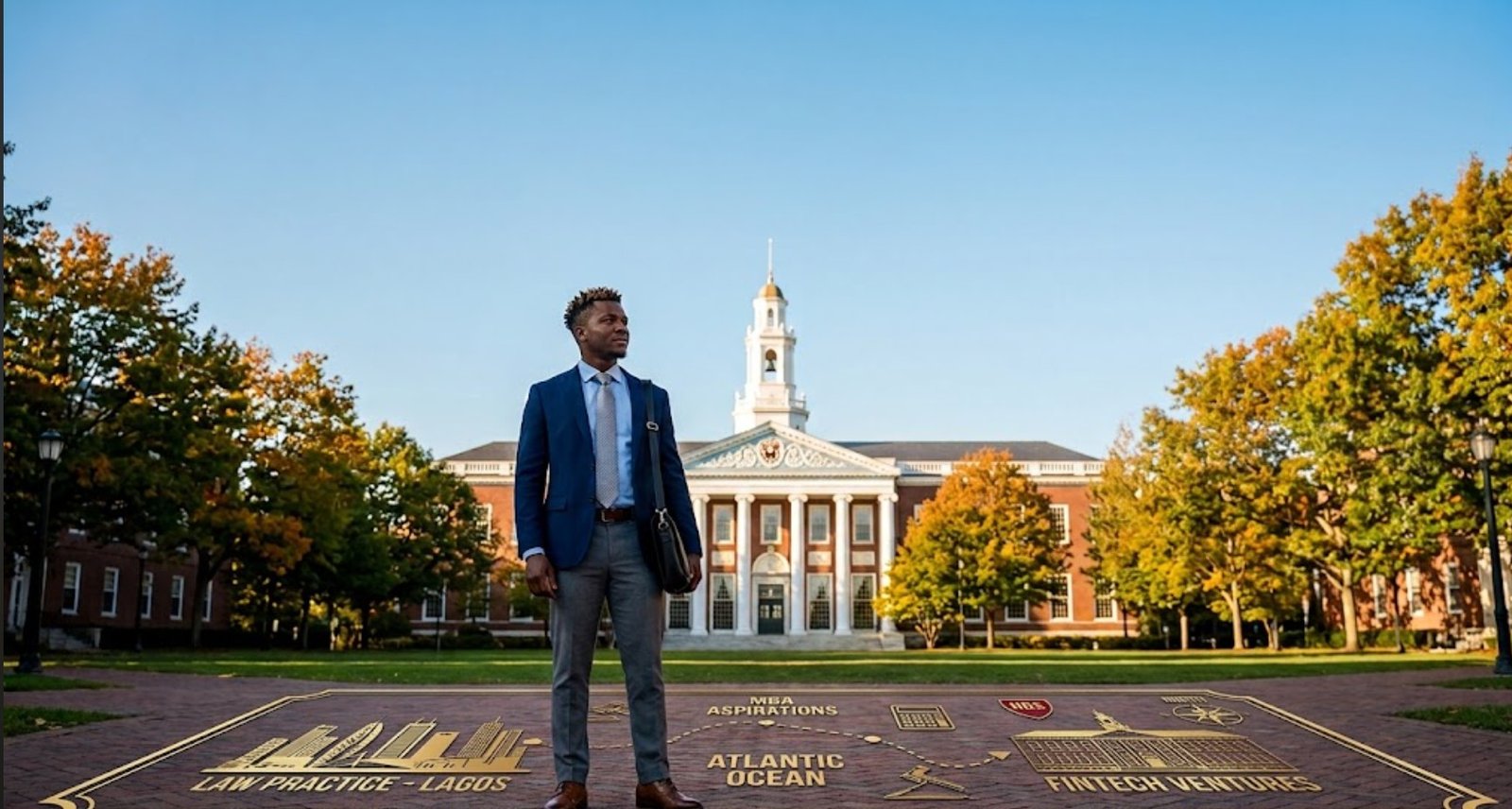
Daniel: My name is Daniel Jayoba. I am currently a second-year MBA candidate at Harvard Business School, soon to be alum—I graduate next month and excited about that.
Prior to business school, I practiced as a lawyer and attorney in Lagos, Nigeria. I did that for about three years before coming to business school, and my focus was more on banking, finance, and fintech. Helping these companies in terms of loan syndication, and then when I moved to fintech, helping either the VC/PE firms or the startups in terms of how to structure their deals, how to protect themselves, and just essentially whoever we were working for, help with the legal documentation. I enjoyed the work!
But prior to actually working as a lawyer, I also went to the University of Lagos where I studied law in Lagos, Nigeria. It was a great time. With the professional experience of my academics and also my profession, I decided to then pivot to an MBA program as opposed to an LL.M., which is the conventional path for lawyers.
I do a number of NGO work—I’m really going through that now—and when I’m not… how I like to relax: I love to travel, and I also love to watch movies!

The Decision to Pursuit an MBA

Ajibola: When you were making those moves, did you have people to look up to? Because I can imagine that this is not the traditional way that people with a legal background end up or want to end up. So did you have people that you looked up to or people that you were reaching out to to give you guidance or advice, or did you just wake up one day and you’re like, “This is what I want to do, this is what I’m doing next”? How did that turn out for you?
Daniel: To be honest, I never knew I was going to do an MBA. An MBA was never in the picture for me. The power of envisioning people and having role models and mentors is actually very important, because all the role models I had are all lawyers, and none of them did an MBA. So I just thought the platform was going to be an LL.M. or just stay in the law firm and go up until partnership.
Instead of considering an MBA, after a very good friend of mine out of the blue just started talking about it—like he loves business and he just said, “Oh, why rather than doing another LL.M., have you ever considered doing an MBA?” And I was like, this is so strange! I discarded it almost immediately, like, we know no one who has ever done an MBA in our circle, so where is this coming from? And I continued on my path to getting an LL.M.
But I think as I started progressing in my career in the law firm, we worked with a number of CEOs of the other companies we were advising as the legal counsel, and I saw the depth that these professionals, the CEOs, brought to the table. After every meeting, I’d go back and check and I’d see: “Oh, this person went to an MBA in this school, this person has an MBA from this school.”
I think for me that was where the idea of the MBA started forming, and I was like: “Okay, you know what? I think my friend was actually onto something.” That was how I then started exploring more about it, got interested, and decided that you know what, I think this would be a great program to actually pursue because I wanted to be like those MDs and CEOs that were spitting strategy.
Ajibola: Exactly! So that was how everything came about. That’s very similar to my answer to a lot of people that I have actually spoken to—like when you see some of the people that you love to be mentored by doing big things, you read their stories and you’re like, “Oh, this person’s got an MBA!” You’re like, “Okay, maybe there’s something that I need to do, there’s something I missed, right?” That’s the power of your network and the power of actually building stories of people and just knowing what is possible for you. Thanks for sharing!

Choosing Harvard & Knowing When It’s Time

Ajibola: So let’s talk about your journey to business school, right? How did you know it was time for that move? What informed your decision to actually choose Harvard? Like, did you apply to other business schools, or were you solely set on Harvard—like Harvard or nothing? How was the journey like for you?
Daniel: Yeah, so you asked like four questions in one, but I think I will put it in two buckets:
  1. How did I know when it was time?
  2. Why did I apply to Harvard? / Why Harvard?
I think for me, the first one on how did I know it was time: I am very big on purpose, I’m very big on passion, and at that point in my career, I think I wasn’t really as thrilled—okay, now I’m being brutally honest—I wasn’t really as thrilled about legal practice as much as I thought I would have been at that stage of my career. At some point, it felt as though things were mundane. I had learned a lot in the legal industry, and after a while, it was as though we were doing the same thing over and over again, but on different transactions and with different clients.
I also wasn’t really, like I said, finding… I didn’t wake up every morning and was like, “Okay, this is what I want to spend the rest of my life doing.” So I think for me, at that point when I got to that point in my career, I felt: “Okay, you know what? If this isn’t what you see yourself doing in the next 10–15 years, and if you think it has become a bit monotonous, isn’t it time to explore something else?”
I started asking myself those questions, and the answer became yes. I was like, “Okay, I think now this is time, and I want to go somewhere where I would wake up every morning and be excited about.” I think for me, that was how I identified that it was time. There are a plethora of reasons to identify when it’s time, but I think for me, that was my personal instance.
Secondly, the question of why Harvard: it was a no-brainer! I think when I think back about my entire experience, it was as though everything was leading me to Harvard Business School, because I remember like when I was age 15, 16, I used to pray about going to Harvard, and it didn’t make any sense to me! I would write it when I go to church, I’d write it on the prayer guide: “Oh, I want to go to Harvard University.” At the time, because I never thought I was going to go to the business school, I just thought maybe it would be Harvard Law School. In retrospect, I remember all those prayers I used to make.
On the other hand, it was just that Harvard was prestigious, and everyone on the street knew the school, Harvard. Also, the alumni network on the continent—the African continent—is huge, so I wanted to tap into that network. I also loved the brand! They say different people go to business school for different reasons—some go for the brand, some go for funding, some go for maybe if the school is big on finance or whatever. The brand was really particular to me, and I think that was why I eventually chose Harvard.
Ajibola: Amazing! I know it’s very important for you to decide what’s critical for you, what you’re looking out for in any school—like is it a particular concentration, is it the fact that they feel like, “Well, this school is a target school for some type of career line,” or stuff. So it’s really important. Thank you!

Crafting a Standout Application

Ajibola: During your application now, what do you think made your application stand out, right, based on what you know now as a current student almost graduating in a couple of days? What do you think made your application stand out?
Daniel: Yeah, this is actually a very powerful question. To be honest, we can do a series on how to make your application stand out, because like I initially said, I didn’t really have anyone in my network that had actually done an MBA, talk less of actually going to Harvard Business School. So I did extensive research as to what they look out for and how to actually stand out.
First of all, I identified that business school programs are built on diversity. So rather than seeing my path coming from a non-traditional background as a disadvantage, I used it as a strength. I think for me that was the foundation and that was the bedrock. As a lawyer, I then tailored my application to how coming from a legal background, I was going to add diversity to the classroom, I was going to bring my own amazing experiences, and would be able to let my classmates learn from me.
From that understanding, I then used it to permeate every aspect of my application. From the resume, I was always bringing it from the light of: “Although I’m a lawyer, this is what I bring to the table, and this is how it can translate to business skills, this is how my classmates can learn from me, this is how I can contribute on the world stage like Harvard Business School,” and really paying attention to the way I was communicating it.
Another thing I think was really major for me: because I didn’t really understand what the school was looking for, I joined all the admissions info sessions. Like, I think if they were taking a roster, I made friends from having gone to different ones because I just really wanted to understand what the school was looking for! To be honest, they actually say these things, but people think they do not mean it, or people for some reason just miss it. So just going for those info sessions really made me understand what they were looking for and just paying attention.
Another thing I did was actually track people on LinkedIn that had gone to Harvard Business School and probably were from Nigeria, from Africa, and just studied their profiles. That gave me an understanding of the candidacy of the type of people that enter the school, and then seeing how I could use my own background to then almost influence and tailor my experiences to that ideal profile. That was essentially what I did.
Ajibola: Thank you for that answer! Honestly, you even touched on my next question. You mentioned three things that are very important:
  1. Attending those informational sessions
  2. Reaching out to people on LinkedIn
  3. Making sure that your stories—everything you write in your essays or your interviews—are personalized and tell what the school is looking for.
I think it’s very important, especially the role of networking, because people never really know what’s in a place from what they read online versus what they get to hear from somebody who has spoken. For instance, somebody is reading right now, they have no links to Harvard, they hear you and they’re like, “Okay, Daniel has said this, I want to know more about it.”
So networking is a huge thing, right? Go on LinkedIn, look for current students wherever you want to go, look for any ties that you can connect with—especially people from an African background. Look for people in the schools that you’re looking to apply to, reach out to them, connect with them. Don’t be offended if people don’t respond to you, because people are busy! But that one person that responds to you, make sure that you get the best use of their time—like you come to the session with good questions, with an open spirit, with so much enthusiasm and stuff. Thank you so much for that!

The Importance of Extracurriculars & Community Work

Ajibola: So do you think—I know you mentioned at the beginning that you are involved in a lot of NGOs and volunteer activities—do you think that any of those volunteer or extracurricular activities played any significant role in your application process?
Daniel: Definitely! I don’t know how you can apply for a top MBA program without having those volunteer activities, because they say that’s what they look out for.
For example, Harvard says they look for three things:
  • Habit of leadership
  • Analytical aptitude
  • Engaged community citizenship
So that community part is a big piece for Harvard Business School. It’s a no-brainer—you actually need to have that experience for you to actually get in. So it played a major part for me, just leveraging that.
Another thing I tell people is it need not be that you went to Mars, or saved the world, or got rid of malaria in Africa. It can be the little things! I know people who have volunteered in church activities, and that was what they used to get in. I know people who have done things for their dad, or their family, or something in their community in terms of their estate or their neighborhood—that was what they used to get in.
I think when we think about community, NGO, or volunteering, we think it must be the most grandiose type of thing, but as long as it’s something that you’re not being paid for, and you’re doing it effortlessly to pay it forward, I think that’s what they look out for. So for me, highlighting the NGO work I’ve been doing over the years—even as far back as when I was in secondary school—was very helpful to show that this was not something I started doing because I wanted to apply to business school. There has been a pattern, and just highlighting that through the application was key.
Ajibola: Thank you for clarifying that! And please drop a comment—if you have any questions. If you have anything to say to Daniel, I’m sure he’ll be eager to hear from you, so please put it in the comment section!

The MBA Internship Recruiting Reality

Ajibola: All right, Daniel, let’s talk about your internship recruitment. How was it? Because many people want to know: after getting into the MBA program, what are the career opportunities like? How is the summer internship recruiting, how easy is it for international students to get roles, and what should people be looking out for—especially knowing what the job market is currently? Can you walk us through how you landed your internship, how long the process took, how you prepared, and what the application timelines were for you?
Daniel: Awesome! I’ve actually never spoken publicly… I think all the interviews I’ve done in the past were just me actually getting into business school. This is the first interview where I’m actually really going to be speaking about the internship process and the application process, so thank you for that!
It was not a walk in the park, and this is just me being honest. I thought, “Oh, getting into Harvard Business School, all my worries and sorrows are over, I can just lazy about going forward.” But with great power comes responsibility! The work I had to do was more, considering the fact that now you are over 900 students at Harvard Business School, so you still have to either compete with your classmates for those roles, or compete with other candidates at other business schools for those roles. So I still had to put in the work.
For me, I came in wanting to do tech—that was my focus. I really wanted to, because I was doing it from the legal side prior to business school, transition to the operations, the strategy, the execution part of it. I really wanted to get my hands in the weeds. I applied to a number of industries and companies in the US, but to be honest, a number of things were not as favorable for me, and I needed to do more work.
When you’re recruiting for an internship, you’re not recruiting based on the school you are at. Yes, the school can give you that platform, but they still need to see your prior experience before coming into the program, and does it actually cater to the role you’re applying for? Because all my prior experiences were legal experiences, the onus was on me to then tweak my legal experiences and actually extract the value and how it would translate to the type of roles I was now looking for in the tech industry.
Trust me, it wasn’t easy! Even getting my resume to that particular phase, I had to go through a series of tweaks and reviews to get my resume to that point.
I then thought applying for my internship, I just applied on what my friend calls “the cold portal”—where you just apply and go to bed. I didn’t know that referrals were a thing! I didn’t know that you could reach out to the recruiters on LinkedIn and try to do a warm type of networking. I didn’t know any of that! I just applied and went to sleep, and I wasn’t getting called back for interviews, and I was always wondering what the problem was.
Immediately when I caught on to that, I started trying to implement referrals, started trying to network with recruiters, and network with people in the industry to ensure that I was giving myself a competitive edge.
Long story short, I eventually landed a role where I was like a general manager in a new country, helping a company expand to a country where they were not before. For me, in the end, I achieved what I wanted to achieve. Although it was not in the US—it was in Uganda—it helped me get my hands dirty! It was like an entrepreneurial role where I was building a company from the ground up in Uganda. It really changed my perspective, changed my skill set. That was how the experience was for me.
Ajibola: Yeah, okay, I can imagine! I’ve spoken to a lot of current students who also had similar experiences as you in regards to internship recruiting, because the job market in the past year was really tough. I like what you said about not just applying and going to sleep. In this day and age, you don’t just apply and go to sleep—you actually take the extra step to go on LinkedIn, find who the hiring manager is or who is working in that room or who is a recruiter, and send messages to them. Not many people reply, but that one person might be the turning point. So thank you for mentioning that!

Advice for Admitted Students

Ajibola: My next question for you: for someone who’s reading right now, they’ve got an admission to business school (might not be Harvard, any school) and they are set to resume in the fall, what advice would you give to them? For someone who is waiting to start school, they’re like, “I’m at the point where I’m almost done with my job, I can’t wait to start business school in a couple of months,” what do they need to be doing? What should they look out for? Should they just be sleeping and waking up and waiting to travel, or what advice do you have for anyone in that situation?
Daniel: Yeah, first of all, congrats on getting into the MBA program! It’s not a walk in the park—lots of hours and labor have gone into that, so congratulations on this new phase in your life. It’s going to be so much fun, and another work! So get ready for that!
What I would say is: the work starts immediately the admission comes. Take a few weeks to celebrate and relax, but in all honesty, the work is just starting. After you’ve gotten out of the bubble of getting in:
  1. Explore Early Career Opportunities: A lot of companies do early recruiting—I didn’t know about this even when I got in. A number of consulting companies do, some tech companies do. Just Googling, putting your ears to the ground, and finding out these opportunities will be very helpful. If you can get an offer before even coming to school, it is the best possible outcome you can get, because by the time you’re recruiting for those offers, they are not really grading you as having MBA experience as opposed to if you’re recruiting after your first year. So put your ears down for those professional opportunities that exist.
  2. Prepare Academically: On the academic front, the MBA is actually very rigorous, and I underestimated how rigorous it could be until I got in. I know some schools actually provide early preparation materials—some require you to take MBA Math or take certain courses. Please take them! Because those will be a foundation for you when you actually start the core courses in the MBA program. It can be very nerve-racking, so just start preparing with the materials they send to you.
  3. Take Time to Rest: Rest, because it’s actually not going to be a walk in the park! I know friends that resigned two days before they resumed in school—it’s not ideal. They came burnt out, they came tired. So you want to actually take some time to rest. Have fun with your friends, have fun with your family, because it’s going to be a different ballgame entirely and you might not have the time to really dedicate to the people you really care about. Just cherish those moments and spend that quality time with them.

Advice for Prospective Applicants

Ajibola: Amazing, thank you so much for that! My question is similar to the last one, but this one is for someone who is hoping to get into business school in an upcoming application cycle. They want to start applying in round one or round two, trying to get into business school by next year—what advice do you have for them, especially someone considering Ivy League schools? What things did you not know during your time that you would tell someone sitting down asking you this question?
Daniel: Yeah, I would say currently there are a number of things you should start doing, because the MBA program in itself is very broad:
  1. Standardized Tests: If you haven’t written your standardized test, this is the best time to start preparing for it, whether the GMAT or the GRE. Schools do not actually differentiate, so you can take whichever you think best suits you. Take time to really start preparing for the GMAT or GRE, constantly taking mock tests to ensure that you’re ready. It’s okay if you take it more than once—I did, and a number of people also did.
  2. Select Recommenders Early: Start reaching out to your recommenders or identifying the people you want to recommend you, because this is the only opportunity a third party actually has to speak to your candidacy. The recommendation is actually very important, and there are different strategies around how you want to go about it. Some people use their prior bosses, some use those they’ve worked with in a community aspect. Just determine what your strategy is and what you want to get from your recommenders, because if you tell them on time, they have more time to prepare and you could guide them as to the different instances and examples you want them to provide to make you a strong candidate.
  3. Demonstrate Leadership: Start taking up a number of leadership positions if you haven’t already, even in your professional organization. You don’t need to be the CEO or a manager to show leadership skills! If you think you haven’t really managed or done anything that shows leadership skills, I don’t think it’s too late for that—you can start building that on the go.
  4. Craft an Authentic Essay: The essay is critical and very important because we generally joke around here and say any robot or ChatGPT can write a standardized test and get a perfect score! The essay is the only opportunity where you get to be personable, where you get to show them that you are beyond your score, beyond your degrees, and beyond your achievements. This is an opportunity for you to really be emotional, vulnerable, and show the color in your personality. Get a scrapbook first, Google the essay prompts for your school, and as you ruminate and think about them, just take down things that come to mind: “I think this would be a great experience to share, I think this would be a good anecdote to use.” Just start taking them down somewhere, and when you start putting your essays together, you’ll have a bank of ready-made resources to leverage.
You’ve got this! Do not be afraid of applying to any school—no school is beyond you. Take that bold step and apply. Don’t self-select yourself out! The worst that can happen is they say no, but do not say that “no” for them when you do not know yet.

Round 1 vs. Round 2 vs. Round 3: The Golden Question

Ajibola: Thank you for saying that! I have one last question that came up: what round do you think is best? Is there a preference for first round, second round, or final round? What round should an international student shooting for an Ivy League school aim for to get the best outcome?
Daniel: This is the golden question! I get this question a lot of times. The answer seems very basic and an answer you’ve heard before, but it’s the fact: apply when your application is the strongest.
For me, I always wanted to apply Round 1 because there was this notion that if you apply Round 1, you have better opportunities of getting in (and some schools also tie their funding to the rounds—Harvard doesn’t, which is another conversation). But by the time I wrote my first standardized test, I didn’t get a score that I thought was befitting of me and my capacity. I wrote the test right before the Round 1 deadline, so I had to write it again. I missed that Round 1 wave, applied Round 2, and still got in!
So I would say go for quality as opposed to trying to beat the time. There is no perfect time—just know that when you apply, you put your best foot forward and you’ve done everything within your power to present your candidacy.
On that note, for schools that have a Round 3: Round 3 is not always ideal because by Round 3, they’ve already almost filled the class size and are looking for those very 1, 2, or 3 exceptional people. You can still apply in Round 3, but know that the stakes are higher and you would need to do more to really show that you belong in the class. But generally, apply when your application is the strongest!

Closing Thoughts

Ajibola Thank you so much! Thank you for sharing your experience with us. Everyone reading, please make sure you drop a comment and say something to Daniel, and if you have any questions.
Daniel: Definitely reach out to current students and alums—they are a goldmine! I used a lot of them when I was applying, and they really changed my application. Look at it this way: they are already in the room you want to get into, and they are the ones who can help you open the door from within. Reach out to them on LinkedIn or Instagram DMs—there is no shame in this game!
Ajibola: It was such a pleasure having you on here, Daniel! Thank you so much for sharing your experience and knowledge with us.

Have any thoughts?

Share your reaction or leave a quick response — we’d love to hear what you think!

You may also like

Leave a Comment