Mastering Management Accounting: Descriptive Questions & My Exam Experience (2026)
Hello guys, welcome back to MBAKen. I hope you are all doing well. Today’s topic is focused on the Descriptive Questions for the Management Accounting paper.
I previously made a blog post about Semester 1 descriptive questions where three of the questions I highlighted actually appeared in the exam!. However, I am writhing this separate blog post for Management Accounting because, during my Semester 1 in 2025, we weren’t provided with any descriptive question banks for this specific subject, unlike our other subjects.
Whether they provide you with a question bank this year or not, I want to share my experience and strategy to help you succeed—especially those coming from non-commerce backgrounds.
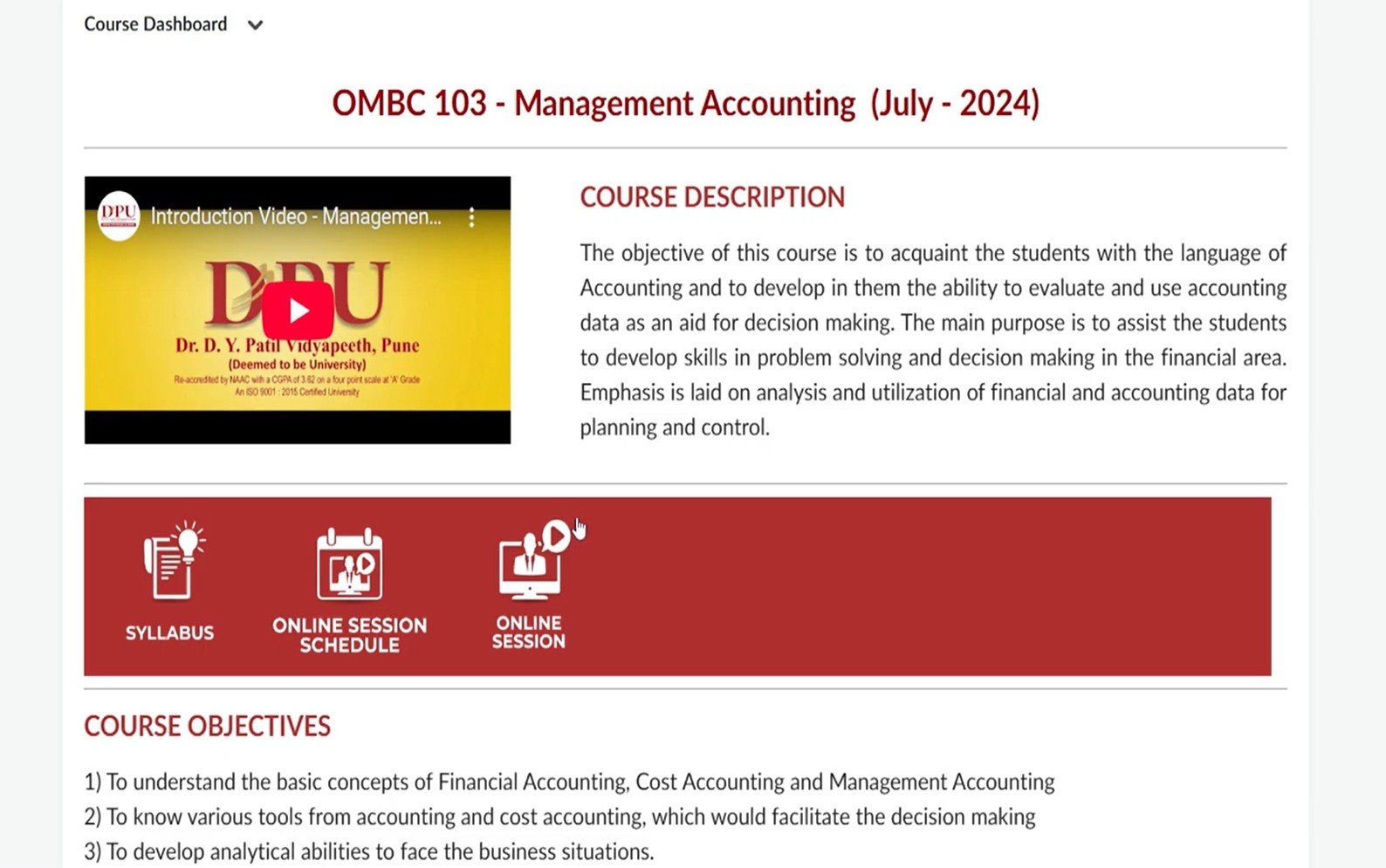
management accounting dpu
Don’t Panic: A Message for Science and Arts Students
I’ve received many comments from students in Science or Arts backgrounds who are worried because Accounting is a completely new world to them.
-
It’s Hard, but Not Impossible: I have seen Science and Arts students successfully complete an MBA in Finance or even an M.Com.
-
The Learning Curve: When I started 11th grade in the Commerce stream, I found it hard too! It just takes time and familiarity.
-
The Goal: Even if you aren’t specializing in Finance (maybe you chose HR or Operations), you still need to pass this core subject. To pass, you need 40% (28 out of 70 marks) in the final exam, but since you are pursuing higher studies, aiming for a better percentage looks much better on your transcript.
Also check out: Dr. DY Patil Online MBA: Admission Process & How to Verify Genuine Counselors
The Exam Breakdown: What to Expect
In my experience, the descriptive section consisted of three questions, and all three were practical (numerical). Do not walk into the exam expecting theory questions for this section.
You are required to attempt two out of three questions, each worth 10 marks.
The “Must-Prepare” Topics:
-
Journal Entries (Mechanics of Accounting): I can practically guarantee that a question on Journal Entries will be there. It is the foundation of accounting. While the university won’t ask for a full Ledger or Balance Sheet because they are too time-consuming for the exam format, Journal Entries are perfect for the time allotted.
-
Accounting of Material Cost: This was the second question I encountered.
-
Other Potential Topics: While I don’t remember the third question, the university often swaps the second or third spot with topics like Overheads, Marginal Costing, Standard Costing, or Budgetary Control.
How to Score 50%+ (The Strategy)
The final exam is 70 marks (50 marks for Section A – MCQ/MCMR and 20 marks for Section B – Descriptive). Here is how you can easily get a high score:
Step 1: Focus on Self-Assessments
Do every single self-assessment in your LMS and at the end of your textbook chapters. More than half the questions in Section A come from here. If you prepare these well, you can easily score at least 35 out of 50 in the objective section.
Step 2: Master the Basics of Journal Entries
If the LMS videos or live classes are confusing, go to YouTube and search for “Journal Entries from basics.” You don’t need to learn the most complex entries—the exam usually tests very fundamental concepts. If you get a 10-mark Journal Entry question right, you’re set.
The Math of Success:
If you score 35 in Section A and even just 5 marks (minimum) in Section B, you have 40 marks out of 70.
$$\frac{40}{70} \times 100 = 57.1\%$$I promised you 50%, and with this simple focus, you’ve already hit 57%!
To help you secure those marks, here is a list of the most common Journal Entry transactions that frequently appear in MBA management accounting exams. These are the “building blocks” you should master.
Common Exam Transactions & Their Entries
When recording these, always remember the Golden Rule: Debit what comes in, Credit what goes out (for assets) and Debit expenses, Credit income.
| Sl. No | Transaction Type | Journal Entry (Debit / Credit) |
| 1 | Business Started with Cash |
Debit: Cash A/c
Credit: Capital A/c |
| 2 | Purchased Goods for Cash |
Debit: Purchases A/c
Credit: Cash A/c |
| 3 | Purchased Goods on Credit |
Debit: Purchases A/c
Credit: Creditor’s Name A/c |
| 4 | Sold Goods for Cash |
Debit: Cash A/c
Credit: Sales A/c |
| 5 | Sold Goods on Credit |
Debit: Debtor’s Name A/c
Credit: Sales A/c |
| 6 | Paid Expenses (Rent/Salary) |
Debit: Expense A/c (e.g., Rent A/c)
Credit: Cash/Bank A/c |
| 7 | Purchased Fixed Asset |
Debit: Asset A/c (e.g., Machinery A/c)
Credit: Cash/Bank A/c |
| 8 | Cash Withdrawn for Personal Use |
Debit: Drawings A/c
Credit: Cash A/c |
Understanding the Journal Format
In the exam, your descriptive answer should be neatly formatted. Even if your calculation is slightly off, providing the correct format can earn you step-marks.
Why These Entries Matter
In an MBA paper, the examiner isn’t looking for complex “pro-level” accounting. They want to see if you understand the Double Entry System—the idea that every transaction affects two sides.
-
Focus Tip: Pay extra attention to “Credit Purchases” and “Credit Sales.” Many students accidentally use “Cash” even when the question mentions a person’s name (which indicates a credit transaction).
Mastering Material Costing (The Second Question)
Since I mentioned Material Costing as a likely second question, you should also memorize the EOQ (Economic Order Quantity) formula. It is a very common 10-mark practical question:
Where:
-
$A$ = Annual Consumption
-
$O$ = Ordering Cost per order
-
$C$ = Carrying Cost per unit per annum
Would you like me to create a simple mock question based on these Journal Entries so you can practice for your exam?
Final Tips
-
Quality over Quantity: It is better to master one or two chapters (like Journal Entries) perfectly than to try and learn everything poorly.
-
Don’t Fear the Paper: Semester 1 is generally designed to be approachable. Follow the strategy above, and you will find the paper quite easy.
If you have any doubts, please leave a comment below. I am working hard to make these topics easy for you.
Have any thoughts?
Share your reaction or leave a quick response — we’d love to hear what you think!
-
 0
0
-
 0
0
-
 0
0
-
 0
0
-
 0
0
-
 0
0
