Let’s be honest: Computer Science is hard. It’s consistently the major with the highest dropout rate (hovering around 10.7% in 2026). While millions of videos promise you a $200,000 salary, free food, and an amazing life, few tell you about the struggle, the failure, and the academic disconnect.
As someone who went through both a Bachelor’s and Master’s from Georgia Tech in Computer Science, I want to give you a major reality check. Here is what I wish I knew before I started.
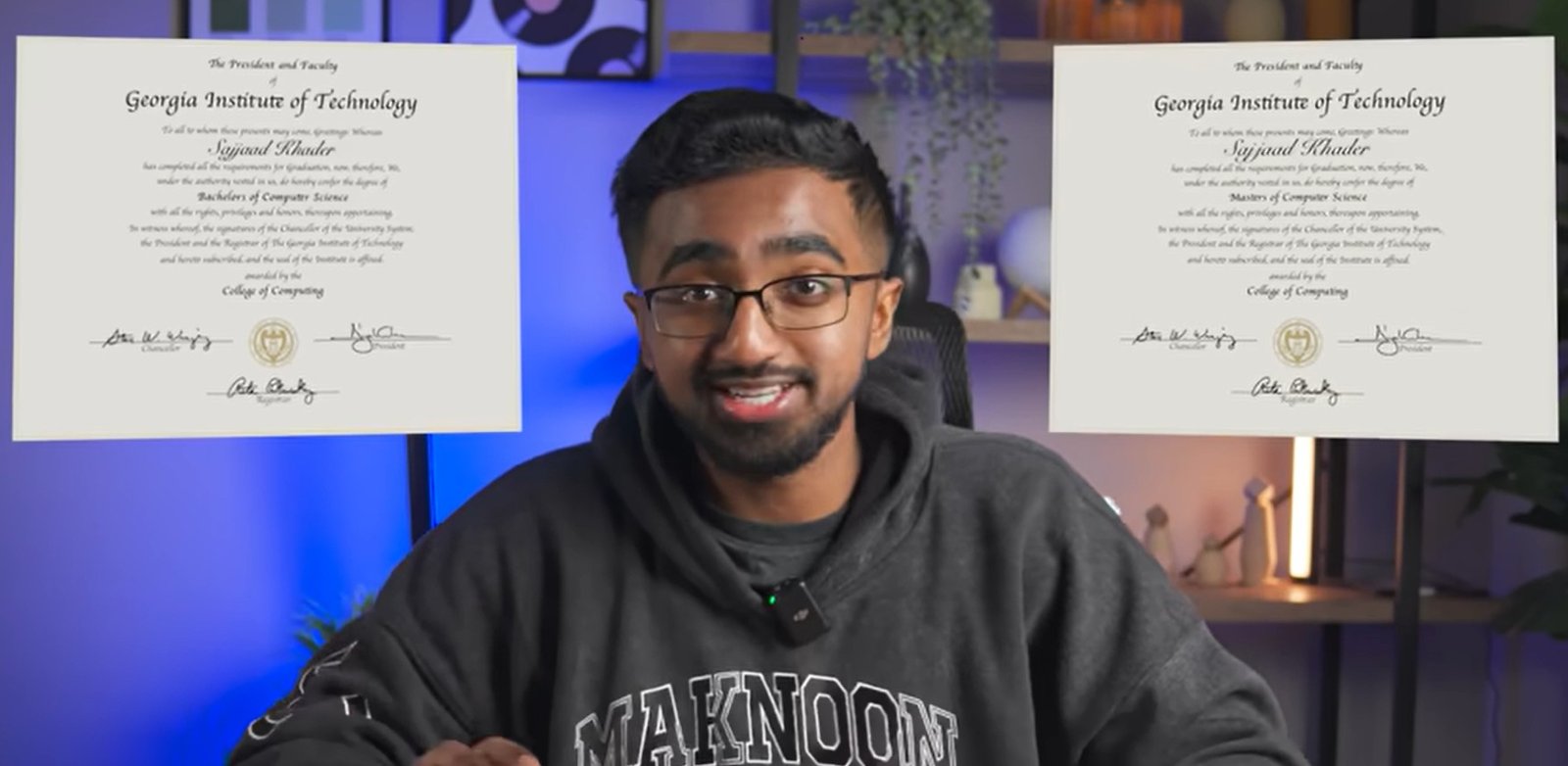
advice to computer science majors
1. The Great Disconnect: CS ≠ Software Engineering
This is my biggest regret. I thought that graduating with a Computer Science degree automatically made me a Software Engineer. It doesn’t. Think of it like this: just because you understand the physics of a compass and how magnetic poles work doesn’t mean you’re qualified to be a ship captain and sail the seas.
-
Computer Science is about theory, math, and understanding the “why” behind the machines (think Discrete Math, Algorithms, and De Morgan’s Law).
-
Software Engineering is about building—web apps, mobile systems, and real-world tools using Agile development, React, or Typescript.
The system is somewhat broken. You spend years learning “atom theory” for computers, but when you graduate, employers only care about what you can build.
2. Most Classes and GPA are “Useless”
I worked myself to the bone for a high GPA, only to realize that out of hundreds of interviews, only one company ever asked for my transcript. As long as you are above a 3.0, most tech giants don’t care.
I took classes like Discrete Math and Applied Combinatorics—math problems with more letters than numbers—and the second the final exam ended, that knowledge vanished. I never used it again.
The 3 Classes That Actually Matter
If you want to land a high-paying job, focus your energy here:
-
Object-Oriented Programming (OOP): Master the four pillars: Inheritance, Polymorphism, Abstraction, and Encapsulation.
-
Data Structures and Algorithms (DSA): This is the bread and butter of technical interviews. Learn your Sets, Lists, Maps, Trees, Graphs, and Big O Notation.
-
Systems and Networks: Crucial for advanced interviews. You need to know how the internet works and how to design architecture for something like Netflix or Spotify.
3. How I Hacked the System: Degrees by 20
I realized early on that focusing on useless classes was a waste of stress.
-
Transfer Credits: I took “useless” required classes like Differential Equations and Physics at a local community college during the summer and transferred them.
-
The Result: Combined with AP credits, I brought 62 credits to Georgia Tech. I finished my Bachelor’s in 2 years (age 19) and my Master’s 1 year later (age 20). By 20, I was earning over $200,000.
4. The 6-Step Framework to Landing the Job
How do you actually get hired? Here is my proven framework:
-
Step 1: Mentally Own It. Rejections are just practice. I landed an Amazon internship as a freshman with zero experience because I refused to listen to people who said “wait until you’re a junior.”
-
Step 2: Fix Your Resume. * Remove your start date (only put your expected graduation date).
-
Remove high school info.
-
Use the Google XY&Z format: “Accomplished [X] as measured by [Y], by doing [Z].”
-
-
Step 3: Gain “Free” Experience. No job? Build something. Watch a tutorial on Hugging Face, grab a dataset from Kaggle, and build a project.
-
Step 4: Network and Referrals. A cold application is often a dead application. Use LinkedIn to get referrals; employees often get a bonus if you’re hired, so they want to help you.
-
Step 5: Start Early. Summer 2026 internships can open as early as May 2025. Be the first to apply.
-
Step 6: Specialize in AI. Take at least one AI elective every semester. Understanding concepts like Reinforcement Learning or AI Prompting (which is now a high-paying career) will future-proof your life.
5. Is AI Taking Our Jobs?
In 2025/2026, AI is a beast. It can summarize notes, create podcasts, and even attend interviews for you. While some fear AI will replace engineers, the reality is that it is augmenting us.
We aren’t being replaced overnight, but the “pure coder” is becoming a “system strategist.” Your job is to learn how to integrate AI into your workflow. Knowledge will always be the solution.
Final Thought: There has never been a better time to be in Computer Science, but you have to be smart about it. Focus on what matters, build real things, and don’t let the theory drown you.
